
The World as Will and Representation: §33–44 (Part 6)
A Reading Guide with Notes and Discussion Questions

Waes Hael,
This is Part 6 of a reading guide for Schopenhauer’s The World as Will and Representation, vol. 1, translated by E.F.J. Payne. You will find here my summary/paraphrase of the text arranged by section and interpolated notes and commentary in brackets.
If you would like to review the background material for The World as Will and Representation, please see my introduction in Part 1.
§33: Knowledge and its relation to the will
As individuals, we have no other knowledge than that which is subject to the principle of sufficient reason i.e. our experience has a particular form because of the kind of creatures we are. Thus if it is possible for us to attain knowledge not just of particular things but of the Ideas themselves, then this can only happen by a change taking place in us, in the subject, which allows the apprehension of such ideas.
Knowledge in general, as we have discussed, is not reducible to materialist subatomic interactions. It is not simply the complex interaction of lower grades of the objectivity of the will. Knowledge is an objectification of the will at a higher grade. Nerves and the brain are the expression of the will at this higher grade of objectification. Representations that arise through these expressions of the will are destined to serve the will “as a means for the attainment of its now complicated ends ...”. Knowledge is the servant of the will. Thus all our knowledge and representations lead back, by a shorter or longer path, to the will.
“As a rule, knowledge remains subordinate to the service of the will,” but this is not always the case. In humans the subjugation of knowledge to the will can sometimes be eliminated. With animals this elimination is impossible. Knowledge is always the servant of the will. This distinction between man and animal is outwardly expressed in anatomy. In animals the head is angled down towards the earth where the objects of the will lie, and this head is a part and extension of the animal’s trunk. In man, the head is distinct from the trunk and is angled upward or forward, instead of downward like the beasts.
§34: The willless subject of knowledge
The individual can only attain knowledge of the idea by renouncing individuation to become a “will-less subject of knowledge.” The will-less subject of knowledge “no longer follows relations in accordance with the principle of sufficient reason,” and instead “rests in fixed contemplation of the object presented to it.”
Raised up by the power of the mind, we relinquish the ordinary way of considering things and the ordinary forms of experience governed by the principle of sufficient reason. These forms of experience (space, time, causality) are ultimately derivative of the will since our bodies and minds are mere objectifications of the will. The forms this mind creates are thus also related to the will and show us the relationship of objects in experience to the will. When we rise to this higher state of mind, however, we no longer consider these forms and their relation to the will. We no longer consider “the where, the when the why, and the whither of things, but simply and solely the what.” Further, abstract thought and reason are not permitted to take possession of consciousness. We instead devote the whole power of the mind to perception and are filled “by the calm contemplation of the natural object actually present.” We forget our individuality and lose ourselves in the object. We forget our will and exist only as a mirror for the object. The perceiver and the perception become one as we forget our own subjectivity and consciousness. We are filled entirely with the object. In this way, the object passes outside of all relation to other objects, in other words, it passes out of the necessary relations to other objects which we understand as space, time and causality. Thus, what is known through this special kind of contemplation is not an individual thing or a particular thing in representation, but the Idea, the eternal form. The individual is no longer individual but becomes a pure, will-less, timeless subject of knowledge who is not bound by the forms of experience.
In this way, the particular thing becomes the Idea it represents and the perceiving individual becomes the pure subject of knowledge. The individual, Schopenhauer says
“knows only particular things; the pure subject of knowledge knows only Ideas. [...] The knowing individual as such and the particular thing known by him are always in a particular place, at a particular time, and are links in the chain of causes and effects. The pure subject of knowledge and its correlative, the Idea, have passed out of all these forms of the principle of sufficient reason. Time, place, the individual that knows, and the individual that is known, have no meaning for them.”
In itself, the idea includes the subject and the object, for these are its sole form. The idea is not in space/time/causality and only has form in so far as it is object for the subject
[What this means, “object for subject,” is unclear. Schopenhauer does not explain how the idea can be an object for a subject even though it does not appear to the subject in any form the knowing subject would be able to cognize. In other words, we have a so-called object-for-subject which can never appear as an object in space or time and is not subject to the law of causality. It thus seems to function as an object only in name. Another difficulty is that the idea, which is pure object-for-subject is outside of space and time. If this is so, how can we speak of singularity or plurality? How can we have the idea of this and not that if we are outside spatio-temporality? How can we examine a single idea or different ideas, all of which seem to presuppose separation in space and time? Should the idea not also be uniform and undifferentiated like the will? Schopenhauer is in a difficult position. He is trying to get “the idea” out of the world of representation while still distinguishing it from the will.]
As we have said, when we are in this higher state of mind, the object becomes nothing but pure representation for the subject outside of space/time/causality. The subject passes entirely into the perceived object, and in a sense, becomes the object itself since the entire consciousness of the subject is nothing more than the image or reflection of the object. “The particular things of all particular times and spaces are nothing but the Ideas multiplied through the principle of sufficient reason ( the form of knowledge of the individuals as such), and thus obscured in their pure objectivity.” Subject and object can’t be distinguished in the idea because the idea is only an adequate objectivity of the will when the subject and object interpenetrate one another. The will is the “in itself” of the idea, the will is the “in itself” of the particular thing and the will is the “in itself” of the individual who knows the particular thing. They are, in this sense, one and the same. They are the will that knows itself. Plurality and difference exist only by virtue of the principle of sufficient reason, which does not apply to the idea or to the will itself. “As soon as knowledge, the world as representation is abolished, nothing in general is left but mere will, blind impulse. When one enters the state of the purely knowing subject, one becomes aware that he is the condition, the supporter of all objective existeince, i.e. he becomes aware that the world of representation depends on the subject and he is able to proclaim with Byron: ‘Are not the mountains, waves and skies, a part of me and of my soul, as I of them?’” He who understands this knows that man is not a perishable being set in contrast to an imperishable world. They are part of one imperishable collectivity.
§35: The Idea vs. ordinary particulars in representation
To reach a deeper insight about the nature of the world, we need to learn to distinguish the will from the idea and then we must learn to distinguish the different grades at which this objectivity of the will (i.e. the idea) appears from the phenomenon of the ideas (i.e. we need to distinguish ordinary particulars in representation from the ideas themselves). Once we do this, we will agree with Plato that only ideas have real being and existence, and we will see that the things that appear to the individual in this world of space and time are only dreamlike.
One and the same idea reveals itself piecemeal in many different phenomena. The way the phenomena come into the observation of the individual, i.e the specific manifestation of the idea as an ordinary object of representation in space/time/causality is inessential. Only the idea itself is essential. For instance, the specific shape of a cloud is inessential, but the nature of the cloud (the fact that it is driven by wind, consists of compressed vapour, etc.) is essential. This essential nature is the essence of the forces that are objectified in the cloud—this is the idea. Schopenhauer gives another example:
“The ice on the window-pane is formed into crystals according to the laws of crystallization, which reveal the essence of the natural force here appearing, which exhibit the Idea. But the trees and flowers formed by the ice on the window-pane are inessential, and exist only for us. What appears in clouds, brook, and crystal is the feeblest echo of that will which appears more completely in the plant, still more completely in the animal, and most completely in man. But only the essential in all these grades of the will's objectification constitutes the Idea; on the other hand, its unfolding or development, because drawn apart in the forms of the principle of sufficient reason into a multiplicity of many-sided phenomena, is inessential to the Idea; it lies merely in the individual's mode of cognition, and has reality only for that individual.”
The same principle holds with regard to higher objectifications of the will, like man. “Consequently, the history of the human race, the throng of events, the change of times, the many varying forms of human life in different countries and centuries, all this is only the accidental form of the phenomenon of the Idea.” The events of the world are significant not in themselves but only in so far as they can reveal the Idea. Only the idea is abiding and essential. The idea of the human race itself is just the objectivity of the will-to-live, which shows its different sides in the qualities, passions, and errors of man—his selfishness, hatred, love, fear, boldness, etc. All of these combine in thousands of different forms and shapes to create individuals who produce the history of the world. The particulars of every event are always different, but the spirit of events is always the same, and if we look, we shall find in history certain recurring characters.
Schopenhauer ends with this:
“Suppose we were permitted for once to have a clear glance into the realm of possibility, and over all the chains of causes and effects, then the earth-spirit would appear and show us in a picture the most eminent individuals, world-enlighteners, and heroes, destroyed by chance before they were ripe for their work. We should then be shown the great events that would have altered the history of the world, and brought about periods of the highest culture and enlightenment, but which the blindest chance, the most insignificant accident, prevented at their beginning. Finally, we should see the splendid powers of great individuals who would have enriched whole worldepochs, but who, misled through error or passion, or compelled by necessity, squandered them uselessly on unworthy or unprofitable objects, or even dissipated them in play. If we saw all this, we should shudder and lament at the thought of the lost treasures of whole periods of the world. But the earth-spirit would smile and say: ‘The source from which the individuals and their powers flow is inexhaustible, and is as boundless as are time and space; for, just like these forms of every phenomenon, they too are only phenomenon, visibility of the will. No finite measure can exhaust that infinite source; therefore undiminished infinity is still always open for the return of any event or work that was nipped in the bud. In this world of the phenomenon, true loss is as little possible as is true gain. The will alone is; it is the thing-in-itself, the source of all those phenomena. Its self-knowledge and its affirmation or denial that is then decided on, is the only event in-itself.’”
§36: Genius and Madness
(if you skipped the previous sections, what Schopenhauer calls “ideas” are similar to what Plato calls “forms.” They exist outside any given particular and embody the essential characteristics common to the entire class—i.e. treeness as opposed to a single tree.)
All sciences follow the principle of sufficient reason in its different forms, and “their theme remains the phenomenon, its laws, connexion, and the relations resulting from these.” We now ask what kind of knowledge is it that tries to understand the Ideas that are the immediate objectivity of the will? This is art, the world of genius. Art repeats the eternal ideas which can be apprehended through the kind of pure contemplation we discussed before. Its sole aim is to communicate these ideas. The material in which art repeats these ideas determines the kind of art it is—sculpture, paintings, poetry, etc. Science can never reach its goal, for it chases an infinite chain of causality. Art is always at its goal and end, for it contemplates the idea which stands outside space/time/causality. Art is “the way of considering things independently of the principle of sufficient reason.” Science and experience consider things in accordance with the principle of sufficient reason.
Only through pure contemplation, in which the subject becomes the mirror of the object, does knowledge of the ideas become possible. A preeminent ability for such contemplation is genius. This type of contemplation requires complete renunciation of subjectivity, the complete forgetting “of our own person and of its relations and connextions.” Thus, genius is the capacity to remain in a state of pure perception. Knowledge of experience originally existed only for the service of the will. The artist divorces this knowledge from the service of his own will and considers it in the abstract, in pure contemplation, setting aside his own interests, aims, desires, personality, etc. For genius to appear in the individual, there must be a surplus of the power of knowledge, a surplus of perceptive capacity over and above what is required for the service of the will. This excess perceptive power is cut off, made free from the will, and becomes the “clear mirror of the inner nature of the world.” This explains the restlessness of men of genius—they are constantly in search of new objects that can fill their consciousness, that can occupy the entirety of their perceptive powers.
Imagination is important for genius, but is not synonymous with genius. Imagination further expands the perceptive powers of the genius. If the man of genius had no imagination, his contemplation of Ideas would be restricted to the Ideas of objects actually present in his own life and would be dependent solely on his personal circumstances. Imagination allows him to extend his vision “far beyond the reality of his personal experience.” Imagination also allows man to see beyond particularity. He sees not just what nature formed, but what nature endeavored to form but could not bring into representation because of the conflict between ideas. It must be noted that a man can have imagination without a trace of genius. In this case, his imagination never reaches knowledge of the idea and creates only imaginary objects to entertain and delight. “Whereas to the ordinary man his faculty of knowledge is a lamp that lights his path, to the man of genius it is the sun that reveals the world.”
Ordinary knowledge of experience, of particulars, is the basis of prudence and rationality. Thus, the genius often neglects this kind of prudence and rationality when engaged in disinterested contemplation. But the genius is not always engaged in contemplation of the idea—indeed, moments of disinterested contemplation appear as moments of inspiration, moments when “the action of a superhuman being different from the individual himself...takes possession of him ...”. Since men of genius are disinclined to the kind of knowledge governed by the principle of sufficient reason, they often have an aversion to math which is only an abstract consideration of the universal forms of the phenomenon. He, the genius, will also have an aversion to logical procedure, which is simply another form of the principle of sufficient reason—logical necessity, the “ground of knowing.” The knowledge of genius is not directed toward the relation of things in representation. It is directed beyond this.
Rational or abstract knowledge is opposed to knowledge of the idea, which does not abide by the laws of logic, the laws of space/time/causality. Thus, the man of genius who contemplates the idea is often given to irrationality and violent emotions, vehemence. The impression of the present moment is very strong with men of genius, as by temperament they have excessive perceptive capacity (we spoke of this earlier). This can carry them away into passion and thoughtlessness. They are inclined to soliloquize, “and in general may exhibit several weaknesses that actually are closely akin to madness. We can see this same belief in the classical tradition. Those outside Plato’s cave basking in the true light of day cannot afterwards see within the cave, because their eyes have grown unaccustomed to darkness, they no longer see the shadow forms. They are thereafter ridiculed for their mistakes, their inability to follow the dance of shadows.” “I will not refrain from mentioning that I have known some men of decided, though not remarkable, mental superiority who at the same time betrayed a slight touch of insanity. Accordingly, it might appear that every advance of the intellect beyond the usual amount, as an abnormality, already disposes to madness.”
A correct and distinct conception of what distinguishes the sane from the insane has never been discovered. The mad possess the faculty of reason and the faculty of the understanding. They talk and comprehend reality. Mad people do not generally err in knowledge of what is immediately present. Their mad talk concerns what is absent and past, and is thus likely a malady specifically affecting memory. They often remember many things, but there is no coherent and continuous connection between the memories. The thread is broken, and where there are gaps in recollection, they fill in invented scenes or momentary fancies. Although they are aware of the immediate present, it is forever mixed up with a fictitious and imaginary past. In severe cases, the influence of this false past prevents the use of the correctly known present.
What shall we make of the fact that violent mental suffering or unexpected and terrible events are often the cause of madness? If such a sorrow or painful knowledge upon reflection is so severe as to be unbearable, then nature seizes on madness as the last means of preserving life. The mind destroys the thread of memory and seeks refuge in madness, fiction, and imagination. A faint analogy of this transition from pain to madness “can be found in the way in which we all frequently try as it were mechanically to banish a tormenting memory that suddenly occurs to us by some loud exclamation or movement, to turn ourselves from it, to distract ourselves by force.”
As we have said, the madman knows the present as well as many particulars about the past but fails to recognize the connection and thus talks nonsense. This is his point of contact with the genius—the genius too leaves out of sight the relations of things, the necessity of certain connections according to the principle of sufficient reason. This is because the individual object of his contemplation or the present he apprehends with excessive vividness appears in so strong a light that the remaining links of the chain are blotted out, like the sun blots out the stars. That which exists in the particular thing imperfectly is enhanced to perfection and seen in the light of the idea it represents. The genius everywhere sees and deals in extremes, in perfection, and thus his actions tend toward the extreme likewise. He knows man profoundly but men very badly; he is easily duped and is the plaything of the cunning and the crafty.
[This archetype of the genius described by Schopenhauer recalls Emerson, who says in his journals: “I like man, but not men.” See also Nietzsche on the philosopher: “A philosopher: that is a man who constantly experiences, sees, hears, suspects, hopes, and dreams extraordinary things; who is struck by his very own thoughts as if from outside, as if from above and below, as if they are experiences and lightning strikes tailor-made for him; who himself is perhaps a storm which moves along pregnant with new lightning flashes; a fateful man, around whom things always rumble and mutter and gape and mysteriously close. A philosopher: alas, a being which often runs away from itself, often is afraid of itself —but which is too curious not to ‘come back to itself’ again and again. . . .” Schopenhauer also says the genius is easily fooled and duped. Nietzsche also speaks highly of this sort of man: “Nobility of mind. To a great degree, nobility of mind consists of good nature and lack of distrust, and thus contains precisely that which acquisitive and successful people so like to treat with superiority and scorn.”]
§37: Art and the “idea”
Genius is the ability to know not individual things, but the ideas they represent. This capacity for recognizing in things their Ideas is present in all men to varying degrees. Were it absent entirely, man would have no ability to create or appreciate art at all. Through art, man communicates the Idea he has grasped and the idea remains unchanged. Knowledge of the idea can thus be reached through art or through contemplation of nature and life. The ability of the artist to grasp the idea is inborn but he lends us this gift by isolating the idea in his work and separating it from all “disturbing contingencies.” We will now consider what takes place in man when he is affected by the beautiful and the sublime.
§38: Detached contemplation of the idea
In the aesthetic method of contemplation, two things are essential: 1. Knowledge of the object not as an individual thing but as a Platonic Idea, “in other words, as persistent form of this whole species of things.” 2. The renunciation of self, personality, and individuality, transformation into the pure, will-less subject of knowledge. These two constituent parts are united by abandoning the method of knowledge that is bound to the principle of sufficient reason i.e., the type of knowledge possible from experience in space and time.
As Schopenhauer said before, the mind and body are objectifications of the will. Thus the a priori forms of experience (space, time, causality) are ultimately derivative of the will since these forms are contributed by sensory faculties and innate structures of the mind (which are themselves only objectivity of the will at a higher grade). These forms show us the relationship of objects in experience to the will. But we want to examine the object in itself, outside of its relation to the will and outside its relation to all other objects. This requires us to consider the object outside of space, time, and causality.
“All willing springs from lack, from deficiency, and thus from suffering.” Fulfillment brings this to an end. Desire goes on eternally—the wish fulfilled makes way for new desires. “No attained object of willing can give a satisfaction that lasts and no longer declines; but it is always like the alms thrown to a beggar, which reprieves him today so that his misery may be prolonged till tomorrow.” Thus, “so long as we are the subject of willing, we never obtain lasting happiness or peace.”
When we direct attention away from the motives of the will and comprehend things free of their relation to the will, when we consider them without interest, purely objectively, then we escape the endless cycle of desire and enter the kind of painless state of peace prized by Epicurus. This is also the state required for knowledge of the idea.
Predominance of knowing over willing can bring about this state in any environment. The Dutch painters achieved this in still-life. They achieved a tranquil, will-free state of mind necessary for contemplating insignificant things objectively. [Of course, the painter cannot move entirely outside time, space, and causality. If he did, the very objects of his study would cease to exist. One cannot imagine the objects of a still life outside of space. One can perhaps imagine them floating in the ether, but they themselves still take up space and are made up of some kind of substance that endures in time. It seems what Schopenhauer means is that the painter contemplates some non-spatiotemporal idea, emotion, spirit, will, essence, etc. and communicates this via specific objectifications of the will i.e., via the objects of the still life, which are spatiotemporal.]
Detached contemplation of the idea can be inspired by objects that invite contemplation, like natural beauty. Sometimes sublime vistas can almost snatch us from our subjectivity entirely, carry us away from the thraldom of the will. We step momentarily into a world where everything that agitates the will and incites the passions no longer exists. As soon as anything with any relation to our will again enters consciousness, it tears us from this pure contemplation. Most men are largely incapable of this pure contemplation; they lack genius, and thus they do not like to be alone with nature. They want company, and seek in all objects some relation to their will. Beautiful surroundings thus always appear to them as hostile, dark, and strange.
The blessedness of will-less perception is also why the past and the far away have a wonderful charm. We recall only the objects in our imagination, not the subject of will that carried so many sorrows. These sorrows and desires of the will are forgotten because they have made way for new desires and sorrows.
[See Nietzsche’s Twilight of the Idols, “Skirmishes in a war with the age,” § 19-24, where he offers an explicit rebuttal to Schopenhauer’s argument.]
Light is considered pleasant and delightful and is the symbol of everything good and salutary, while darkness symbolizes despair and damnation and gloom. Light makes us happy, and its absence makes us sad. Colors delight us. This is because “light is the correlative and condition of the most perfect kind of knowledge through perception.” Sight is a unique sense. It has no direct connection to the will, to pleasantness or unpleasantness. Sights alone do not excite pain. Heat causes pain, and so can loud sounds, but sights alone do not. Taste and smell are most closely related to the will, as they are always either pleasant or unpleasant. They are also the most ignoble, for they are hardly capable of any objectivity. Pleasure from light is actually pleasure from the objective possibility of the purest and most perfect kind of knowledge from perception. It is the pleasure not of an appeased will, but of a soul delivered from willing into pure knowing.
§39: The Sublime and the Beautiful
There is thus pleasure in the pure delight of perception in contrast to pleasure that comes from gratification of the will.
Now we will discuss a related concept—the sublime. The transition into the state of pure perception can be aided by objects that accommodate this kind of perception, objects that easily become representatives of their ideas, “in which beauty, in the objective sense, consists.” Natural beauty and the plant world in particular have this quality that invites pure perception and aesthetic pleasure in that pure perception. This is perhaps because plants themselves lack representative capacity and thus need the animals to leave the world of blind willing and come into the world of representation. They yearn for this entrance into the world of representation and are thus perhaps especially attuned to attract the perceptive, representational faculties of animals. As Augustine puts it, “because they are unable to know, they may appear, as it were, to want to be known.”
If we contemplate the ideas individualized in nature, if we move from knowledge of relations of objects to a more perceptive aesthetic contemplation, then it is beauty that affects us and the feeling of beauty that is excited. But these objects which invite us to pure contemplation may have a hostile relation to the human will as manifested in its objectivity, the human body. The summit of a high mountain may be quite beautiful, but is quite hostile to the human form. Nevertheless, the beholder can detach himself from the will and consider the mountain peaks not as something dangerous but as something purely aesthetic. This is pure will-less contemplation of the idea. In this case, he is filled with the sublime and raised to a state of exaltation. The sublime differs from the beautiful. With the beautiful, pure contemplation has gained the upper hand without a struggle. As Schopenhauer puts it, “the beauty of the object, in other words that quality of it which facilitates knowledge of its idea, has removed from consciousness, without resistance and hence imperceptibly, the will and knowledge of relations that slavishly serve this will.” One could think of a flower. The flower is not hostile to the human will, and thus one slips more easily into a kind of detached contemplation. The will puts up no resistance. The sublime, on the other hand, is a state of pure contemplation attained only by violently tearing away from an object’s relationship to the will, a conscious dismissal of an object’s hostile relationship to the will. This tearing away must be effected and maintained consciously, and thus is accompanied by a constant recollection of the will. This recollection is not a single individual willing like fear or anxiety which would tear one away from detached contemplation, but only a general recollection of human willing as expressed in its objectivity, the human body.
There are several degrees of the sublime in human experience. These degrees are stages of transition between the beautiful and the sublime. When one moves beyond the known hostile relation of the object to the will, there is a feeling of exaltation. When this feeling of exaltation is feeble, this is only a weak form of the sublime; when it is loud and clamorous, that is a stronger form of the sublime.
Man is both a dark impulse of willing and the serene subject of pure knowing. This is symbolized by the genitals and the brain. Similarly, the sun is simultaneously the source of light, the condition of the most perfect kind of knowledge— and the source of heat, the first condition of all life (in other words, the precondition of every phenomenon of the will at its higher grades. The human body is a higher grade of the will. Heat is necessary for its existence.) Just like heat is necessary for the will and objectifications of that will (human bodies), light is the first condition of knowledge. If beauty is knowledge of the idea achieved through detached contemplation, then light is very important in considerations of beauty. Indeed, its presence is generally an indispensable condition for beauty, and its favorable arrangement at the very least enhances beauty. The beautiful in architecture is certainly enhanced by light, and through ligh,t insignificant things can become beautiful.
If we see a mountain in winter in the sun, we see light without heat. The precondition of knowledge is present—light, but there is no heat which could gratify the will. Thus, there is an absence of the principle of life or the conditions for life, and thus some transcending of the interest of the will is required. The will is slightly alarmed, and to abide in pure knowledge, we must turn away from the will. This is an example of a slight trace of the sublime in the beautiful. The coldness of the mountain is slightly hostile to the will and requires some overcoming before we can enjoy pure contemplation of the light on the snow.
Next, says Schopenhauer, we might imagine a North American prairie. Boundless horizon, clear sky, trees, plants, but no animals, humans, water, or sound. This surrounding is a summons to pure contemplation, but this scene of pure solitude affords no objects either favorable or unfavorable to the will, which needs always strife and attainment. To engage in pure contemplation, man must thus overcome the terrible misery and boredom of the unoccupied will. There is thus slightly more of the sublime in the prairie than in the winterscape.
Now imagine a desert, totally deprived of all that is necessary for life. The desert has a fearful character, and “the exaltation to pure knowledge comes about with a more decided emancipation from the interest of the will and by our persisting in the state of pure knowledge, the feeling of the sublime distinctly appears.”
Next, we can imagine dark storm clouds or immense cliffs, or rushing rapids. Our struggle with nature, our body in terrifying peril, all this appears very clearly to us. If we can comprehend calmly, unshaken and unconcerned these vistas and the ideas in those threatening objects around us, then this brings on a quite strong feeling of the sublime since we still retain a recollection of the will which is in great danger, a will that the natural world threatens to overcome and subdue.
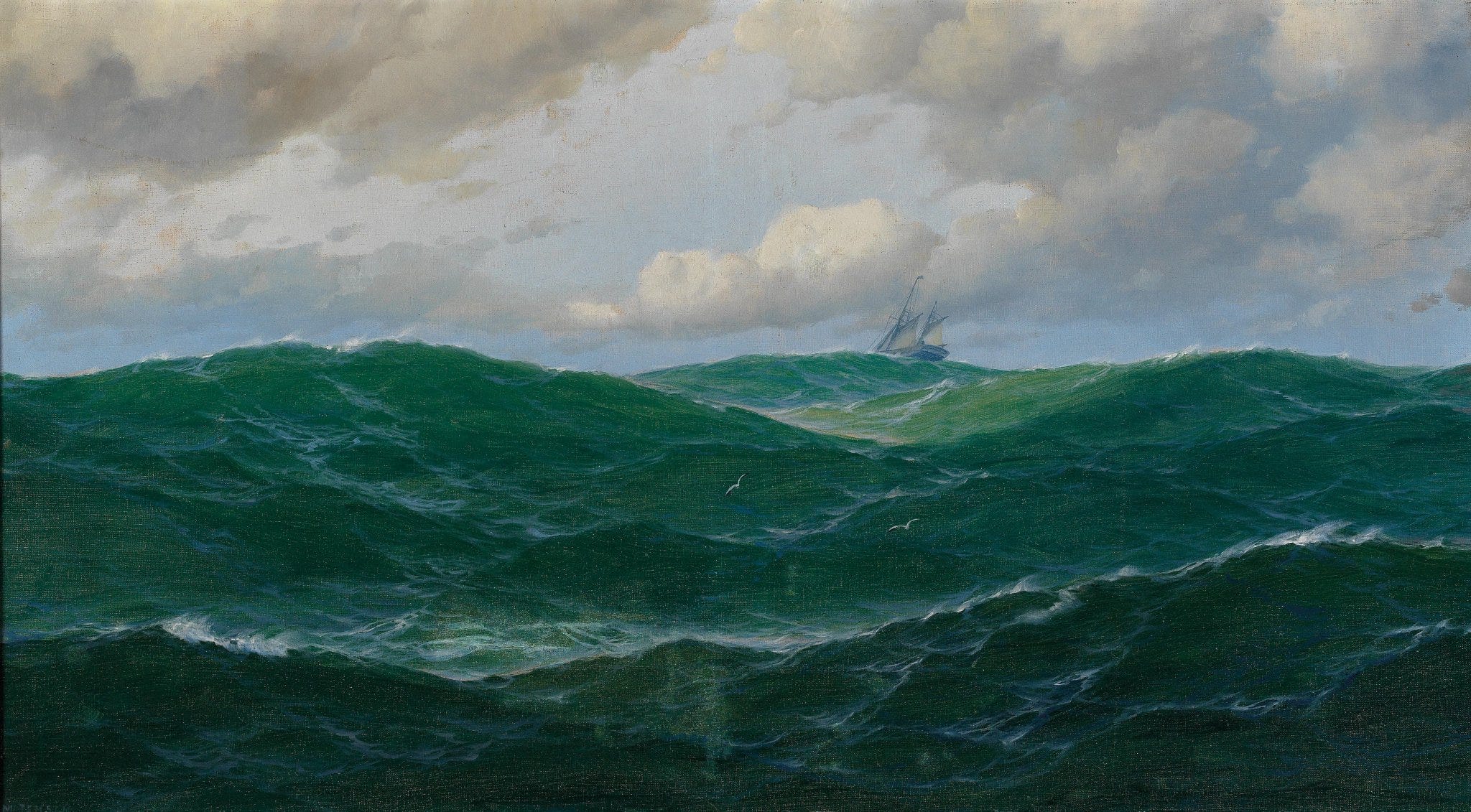
Now the feeling of the sublime is even greater if we imagine ourselves tossed and pitched at sea by mountainous waves. A storm rages all around, the wind howls, and lightning flashes from the black clouds. Here, our will is helpless against the forces of nature, and the slightest touch threatens to annihilate the will. But at the same time, man is conscious of his condition as a serene subject of knowing, supporter of the world, quiet contemplator of the ideas. “This is the full impression of the sublime. Here it is caused by the sight of a power beyond all comparison superior to the individual, and threatening him with annihilation.”
We can also gain this impression of the sublime by contemplation of the magnitude of space and time, which reduce our individual selves and individual willing to nought. We see that all our willing is transient, that our living bodies are transient, that we are like drops of water in the ocean of time. But we also see that all this vastness exists only in representation, only as “modifications of the eternal subject of pure knowing.” This allows us to move beyond our individuality and into pure will-less contemplation. Schopenhauer calls this the mathematical sublime.
We can also think of the sublime in the realm of the ethical—sublime character. This is a character in which the will is not excited by objects well calculated to excite it, but always knowledge retains the upper hand. This kind of man considers others in a purely objective way, not in relation to his own will. The man of sublime character can contemplate others without the feeling of envy or hatred, even if they have done him wrong. His personal happiness or unhappiness will not violently affect him.
§40: The Charming
The real opposite of the sublime is the charming or the attractive—that which “excites the will by directly presenting to it satisfaction, fulfillment.” The sublime is when something unfavorable to the will becomes the object of pure contemplation. The charming or attractive draws the subject away from pure contemplation towards awareness and gratification of the will. The charming is sometimes mixed with the beautiful in art but the charming detracts from beauty which arises from pure contemplation of the idea. Dutch paintings of edible fruits are one such example of the charming. Here, the detached and contemplative attitude inspired by the still life is suddenly disrupted by the appetite and the reemergence of the will. This also occurs in certain paintings and sculptures when nude figures are calculated to excite lust. This abolishes purely aesthetic contemplation.
There is also the negatively charming “even more objectionable than the positively charming just discussed, and that is the disgusting or offensive.” This rouses the will by inspiring repugnance. This is inadmissible in art, which can tolerate the ugly so long as it is not disgusting.
§41: Beauty and the idea cont.
Schopenhauer notes, “[t]he difference btween the beautiful and the sublime depends on whether the state of pure, will-less knowing, presupposed and demanded by any aesthetic contemplation, appears of itself, without opposition, by the mere disappearance of the will from consciousness, since the object invites and attracts us to it; or whether this state is reached only by free, conscious exaltation above the will, to which the contemplated object itself has an unfavourable, hostile relation, a relation that would do away with contemplation if we gave ourselves up to it.” The difference is in the state of the subject, not in the nature of the object being contemplated.
By calling an object beautiful, we mean that it is an object of aesthetic contemplation. This implies two things. 1. Our contemplation is objective, meaning we are not conscious of ourselves as individuals but only as pure will-less subjects of knowing. 2. We recognize in the object not the individual thing, but the idea it represents. This can only happen if our contemplation of the object “is not given up to the principle of sufficient reason,” meaning we do not consider the relation of the object to things outside it (including our will).
The idea and the pure subject of knowing appear as necessary correlatives. Both lie outside time and space and are foreign to the principle of sufficient reason in all its forms. If you contemplate a tree and consider its idea, the differences between individual trees become irrelevant. Similarly, it makes no difference whether the individual contemplating is you or another being from 1000 years ago. The particular thing and the particular individual are both abolished when we step outside the principle of sufficient reason. The idea is released not only from time but also from space. The idea is not really a spatial form that floats before the observer. It is something else, an innermost being wholly the same in all its parts and absent of any spatial relations in form.
Since even the most insignificant thing is the expression of some idea, and this idea admits of will-less contemplation, everything is beautiful. One thing may be more beautiful than another because it facilitates or compels purely objective contemplation or because the relation of parts expresses purely the idea of its species. Alternatively, sometimes the special beauty in an object is to be found in the idea itself, which is a high grade of the will’s objectivity and is thus more significant and suggestive. This is why man is more beautiful than other objects and why “revelation of his inner nature is the highest aim of art.” Plants, rocks, and other inanimate objects also have beauty, but the idea they represent is an objectification of the will at a lower grade. Gravity, fluidity, light, and rigidity are the ideas expressed in these objects. Architecture and landscape gardening can help these objects to “unfold their qualities distinctly, perfectly and comprehensively,” and thus, in this way, “invite and facilitate aesthetic contemplation.” Bad buildings can still be contemplated, and the idea is still recognizable in them, but the structure hinders rather than facilitates contemplation.
Manufactured articles, like tables or chairs, can only lead us back to the Idea of the material which has been given artificial form. So pure contemplation of a chair does not, as Plato believed, lead us to the Idea “chair.” It leads us back simply to a human conception of furniture or a human conception of a thing used for sitting, but this is not an Idea. Pure contemplation of the mere material from which the chair is made can lead us back to basic Ideas like rigidity or gravity, but the accidental shape that has been given to this material (the shape of a chair) is not representative of an Idea. There are only as many ideas as there are natural things and entities.
Plato’s theory that art expresses the individual thing but not the idea is also a major point of disagreement. Schopenhauer believes the opposite.
§42: The source of aesthetic enjoyment
Knowledge of the beautiful requires a knowing subject and a known idea as object. Sometimes, the source of aesthetic enjoyment is the known idea, and sometimes it is the bliss and peace of mind that comes from being free from willing and striving. The predominance of one kind of enjoyment over the other will depend on whether the idea contemplated is of a higher or lower grade. When only ideas of a lower grade are apprehended (for instance, when contemplating natural beauty or plants or the inorganic), the knowledge of the idea is not of deep significance, and the greater aesthetic enjoyment is in freedom from willing and striving. On the other hand, when humans and animals are considered, the idea contemplated is of a much higher grade, and the knowledge of the idea is much more significant. The source of aesthetic enjoyment in this case is the known idea itself, which is a distinct revelation of the will.
§43: Architecture
Matter itself cannot be the expression of an Idea. As we saw earlier, matter is just causality and its being is in acting. Causality is a form of the principle of sufficient reason, but knowledge of the idea is outside the principle of sufficient reason. Further, we saw in the second book that matter is the connecting link between the idea and the phenomenon. Thus, matter is not the expression of any particular idea and cannot lead us back to an idea through pure contemplation. The idea reveals itself in qualities and forms in representation, but matter itself is not an object of perception—it can only be conceived as an abstraction, only as the thing that is common in all representations. Ideas have to appear as things (matter) with qualities (form) for them to be objects of perception.
Plato is therefore correct when he said that matter is different from both the idea and the individual thing. Matter enables the idea to be objectified in the world of representation, but matter is not itself the idea or the individual thing in representation. Qualities of matter, meaning its specific form and specific attributes in a given object, are expressions of an idea, but matter generally, considered as underlying substance, has no particular qualities or form.
Architecture, considered as an art, has no purpose other than that of “bringing to clearer preceptiveness some of those Ideas that are the lowest grades of the will’s objectivity.” Such Ideas are gravity, cohesion, solidity, hardness, etc. The conflict of these ideas,
“is the sole aesthetic material of architecture; its problem is to make this conflict appear with perfect distinctness in many different ways. It solves this problem by depriving these indestructible forces of the shortest path to their satisfaction, and keeping them in suspense through a circuitous path; the conflict is thus prolonged, and the inexhaustible efforts of the two forces become visible in many different ways. The whole mass of the building, if left to its original tendency, would exhibit a mere heap or lump, bound to the earth as firmly as possible, to which gravity, the form in which the will here appears, presses incessantly, whereas rigidity, also objectivity of the will, resists. But this very tendency, this effort, is thwarted in its immediate satisfaction by architecture, and only an indirect satisfaction by roundabout ways is granted to it. The joists and beams, for example, can press the earth only by means of the column; the arch must support itself, and only through the medium of the pillars can it satisfy its tendency towards the earth, and so on. By just these enforced digressions, by these very hindrances, those forces inherent in the crude mass of stone unfold themselves in the most distinct and varied manner; and the purely aesthetic purpose of architecture can go no farther. Therefore, the beauty of a building is certainly to be found in the evident and obvious suitability of every part, not to the outward arbitrary purpose of man . . . For only by each part bearing as much as it conveniently can, and each being supported exactly where it ought to be and to exactly the necessary extent, does this play of opposition, this conflict between rigidity and gravity, that constitutes the life of the stone and the manifestations of its will, unfold itself in the most complete visibility.”
The form of each part must be determined by its purpose and relation to the whole. Its form should not be arbitrary and unrelated to its essential role in the conflict between opposing forces. If we believe a structure is made of stone and discover it to really be made of wood, our aesthetic enjoyment decreases because the fundamental relationships between natural forces have been shifted. What was thought to be a dramatic opposition between gravity and rigidity is revealed as an illusion. The relationship between rigidity and gravity has been altered, and thus the significance and necessity of the parts have been removed. Our enjoyment of architecture comes from contemplating the interplay of those “fundamental forces of nature, those primary ideas, those lowest grades of the will’s objectivity.”
When a fine work of architecture is created, special consideration is always given to the effect of light. Strong illumination makes the relations of the parts, the dynamic interplay of forces clearly visible. Architecture also reveals the nature of light, obstructing, impeding, and reflecting with various forms to reveal the nature and quality of light in the “purest and clearest way.”
Since the ideas brought to clear perception by architecture are the lowest grades of the will’s objectivity, the objective significance of what is revealed in pure contemplation is relatively small. The primary aesthetic enjoyment gained from architecture is thus not the known idea (gravity, rigidity, etc) but the emancipation from willing, freedom from individuality and suffering and striving, which occurs when we enter a purely contemplative state. The opposite of architecture is drama, which reveals the highest grades of the will’s objectivity. Here, the aesthetic enjoyment is in knowledge of the idea itself.
Architecture does not repeat the known Idea. It does not give us a copy. It simply presents the object to the beholder and makes the apprehension of the Idea easy by bringing “the actual individual object to a clear and complete expression of its nature.”
Architecture is rarely purely aesthetic. Often, aesthetic considerations in architecture are subordinated to practical ends that are foreign to art itself. “Thus the great merit of the architect consists in his achieving and attaining purely aesthetic ends, in spite of their subordination to other ends foreign to them.” Architecture is constrained by necessity and utility but also preserved by these same constraints, for without the necessity of building, it’s unlikely that architecture would persist on its own. Architecture is also a field where aesthetic and practical concerns are not in particular conflict. In other arts, they certainly are in conflict. For instance, there is surely a kind of art to hydraulics. Here, the ideas that govern water—gravity, fluidity, mobility, transparency—can be brought to dynamic and aesthetic interplay, but because practical hydraulics and aesthetic hydraulics have little compatibility, there is hardly any art of aesthetic hydraulics.
§44. Artistic horticulture and the lower grades of painting
Architecture deals with lower grades of the will’s objectivity (gravity, rigidity). Artistic horticulture deals with slightly higher grades of the will’s objectivity (plant matter). Landscape beauty depends on the multiplicity of natural objects which appear distinct from one another while remaining in complementary association. Most of the beauty in horticulture is supplied by nature itself, and thus there is a good deal less art in horticulture than architecture.
The plant world becomes true art in the medium of landscape painting. In paintings of architecture or ruins, the subjective side of aesthetic pleasure is dominant. In other words, it is our will-less state of contemplation that is aesthetically enjoyable. The painter allows us to see the world through his eyes and induces a state of profound spiritual peace. The effect of landscape painting is similar, but because the ideas manifested are of a higher grade, they are more significant and suggestive, and the objective side of aesthetic enjoyment (enjoyment of the known idea) comes to the forefront.
An even higher grade of objectification of the will is revealed in animal painting and animal sculpture. In looking at these pieces of art, the subject still silences his own will, but the effect is not felt, “for we are occupied with the restlessness and impetuosity of the depicted will.” Here, the will is not tempered by thoughtfulness but manifests “naively and openly, feely and evidently. Ad precisely on this rests our interest in animals.”